
Where the Light Gets In: What Peer Support Taught Me About Healing, Community Care, and Youth Agency
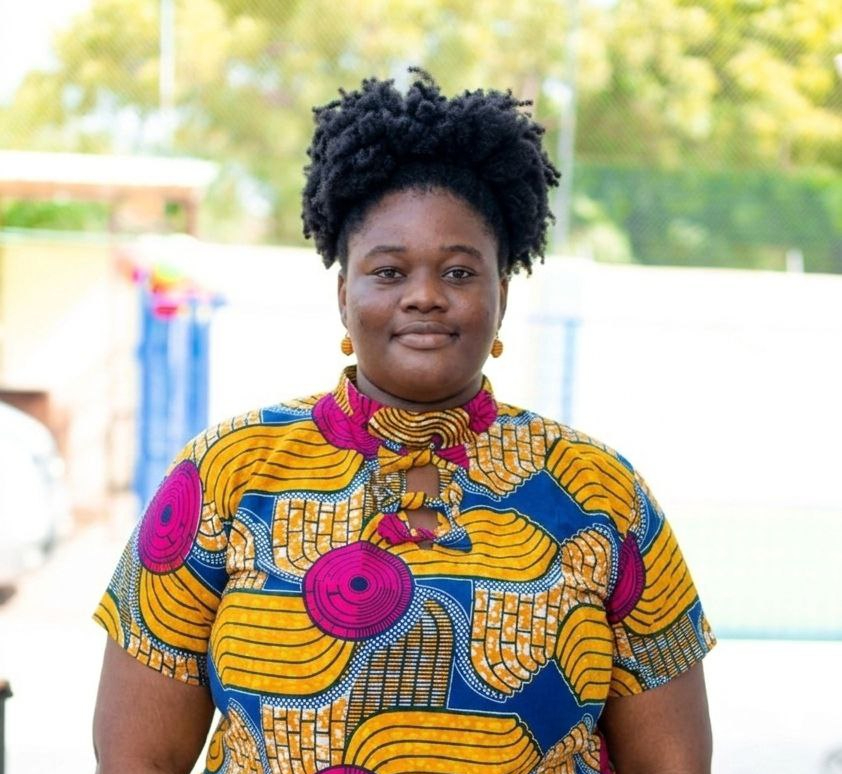
Written by: Hear/SAY contributor Blessing Adams.

As a person living with anxiety, overthinking is a fixed staple. I can not imagine my life without it. Picture banana pudding without vanilla wafers or Divergent without Tobias; it just doesn’t work. Lately, though, I am channeling all the tips I see on social media from gurus and trying to embrace balance. Writing this is my first attempt at quieting all the jumbled-up thoughts in my head. The first time I knew there was a real problem was in 2020, my second year in university. My friend had a breakdown, and I knew this time around was different. My words and love were not going to be enough to soothe them. We managed through the night and rushed to the university hospital first thing the next morning. The craziest part is we left an hour after.
I still remember the nurse at the reception desk, in her pretty uniform, saying, “I’m so sorry. I can feel your urgency, but our psychiatrist is only around on Wednesdays. Come back in two days.” I remember feeling scared and wondering how I was going to keep another human safe just months after my 18th birthday.
You know what, let’s rewind. That wasn’t the first time.
I remember being in a religious boarding school without a single counselor or psychologist. Peer support became the difference between giving up and survival for many of us. This still stands true today. In that boarding school, when there was no counselor, I helped my friends dealing with grief by sharing my own experiences. Hey, at least having a dead father did some good! I vented to roommates who truly understood the weight of that environment, when even the most mundane conversations with authority figures and other students felt hostile and overwhelming. We cried together, found joy in the smallest things, and kept each other going day by day.
The Power of Peer Support and Choice
There’s something almost sacred about peer support. The act of being reflected in someone else and given space to be your truest self without pretense almost feels ceremonial.
Knowing that someone is pouring into you, not out of a book or theory but with expertise that is hard-won and battle-tested, is a great measure of love. My favorite part is that this is not a singular event. It compounds beautifully, forming a mycelium of shared wisdom and care. Those who receive support end up paying it forward and supporting others too; an unmatched cycle.
Peer support held us together in that boarding school. But in 2020, I came face to face with something it couldn't fix. My friend needed something I couldn't give them. We got back from the hospital, and I barely slept for two nights. I was afraid to close my eyes and leave them alone. Afraid of what might happen in the small hours when grief and darkness tend to win. Sad that I couldn’t provide what they needed. Wednesday felt very far away. When we finally got to see the psychiatrist, something shifted. Not because I had failed them, but because this was what they had asked for. They knew what they needed and were finally getting it. That mattered more than anything.
It has never been an issue of peer support versus professional care. I believe there is a place for therapy, medication, community care, social policy that regards disparities, or spirituality, depending on the individual’s needs. The problem arises when young people are not given a say in the matter, and multiple routes aren’t offered.
Cost is also a huge part of the equation. The university psychiatrist was free, and that is the only reason it was even an option for us that day. For many young people, professional help exists in theory but not in practice. Peer support can complement medication. Therapy can coexist with faith. It’s not always an either/or issue. The Blueprint for Agency in Youth Mental Health
If you take nothing else from all I’ve said, please remember this.
Any interventions being designed for young people should be comprehensive and holistic.
Low-cost, considering the present economic reality.
Center youth voice and agency right from the start; involve us in the creation process.
Accessible in messaging and wording.
Create spaces for us to grieve together, reclaim our joy, and find healing.
Give us the option of choice and autonomy.
Depending on our individual needs, create avenues for us to get professional help, an inspiring piece of scripture, or warm words from someone who gets it because they have been there too.
I have been the person holding someone together, and I have been the person who needed holding. Here’s to finding our way through….
Author Bio:
Blessing Adams is a youth mental health advocate, paraprofessional counselor, and lived experience practitioner based in Ghana. She serves as an Expert Advocate for Global Lived Experience with Aves Mental Health and is the founder of The Revel Project, a community-driven initiative that builds peer-led wellbeing ecosystems for young people in Ghana. Her work sits at the intersection of youth mental health, human rights, and inner development for outer change, grounded in a lens of interconnectedness and constructive hope. She is a member of the IDG Foundation's International Youth Council.
Disclaimer: BHT Impact does not provide emergency support or real-time crisis intervention.
If you or someone you know is in immediate danger, call 911 or go to the nearest emergency room.
For mental health crisis support, please reach out to:
988 Suicide & Crisis Lifeline — Call or text 988 (24/7)
Crisis Text Line — Text HOME to 741741 (24/7)


Comments